
Pokémon Type Chart
The complete Pokémon Type Effectiveness Chart — check strengths, weaknesses, resistances, and immunities for every type matchup at a glance.
View Full Type ChartComplete Pokémon Type Effectiveness Chart
Rows show the attacking type, columns show the defending type. Find where a row and column meet to see how effective that attack is.
| ATK \ DEF | Normal | Fire | Water | Electric | Grass | Ice | Fighting | Poison | Ground | Flying | Psychic | Bug | Rock | Ghost | Dragon | Dark | Steel | Fairy |
|---|---|---|---|---|---|---|---|---|---|---|---|---|---|---|---|---|---|---|
| Normal | — | — | — | — | — | — | — | — | — | — | — | — | ½ | 0 | — | — | ½ | — |
| Fire | — | ½ | ½ | — | 2× | 2× | — | — | — | — | — | 2× | ½ | — | ½ | — | 2× | — |
| Water | — | 2× | ½ | — | ½ | — | — | — | 2× | — | — | — | 2× | — | ½ | — | — | — |
| Electric | — | — | 2× | ½ | ½ | — | — | — | 0 | 2× | — | — | — | — | ½ | — | — | — |
| Grass | — | ½ | 2× | — | ½ | — | — | ½ | 2× | ½ | — | ½ | 2× | — | ½ | — | ½ | — |
| Ice | — | ½ | ½ | — | 2× | ½ | — | — | 2× | 2× | — | — | — | — | 2× | — | ½ | — |
| Fighting | 2× | — | — | — | — | 2× | — | ½ | — | ½ | ½ | ½ | 2× | 0 | — | 2× | 2× | ½ |
| Poison | — | — | — | — | 2× | — | — | ½ | ½ | — | — | — | ½ | ½ | — | — | 0 | 2× |
| Ground | — | 2× | — | 2× | ½ | — | — | 2× | — | 0 | — | ½ | 2× | — | — | — | 2× | — |
| Flying | — | — | — | ½ | 2× | ½ | 2× | — | — | — | — | 2× | ½ | — | — | — | ½ | — |
| Psychic | — | — | — | — | — | — | 2× | 2× | — | — | ½ | — | — | — | — | 0 | ½ | — |
| Bug | — | ½ | — | — | 2× | — | ½ | ½ | — | ½ | 2× | — | — | ½ | — | 2× | ½ | ½ |
| Rock | — | 2× | — | — | — | 2× | ½ | — | ½ | 2× | — | 2× | — | — | — | — | ½ | — |
| Ghost | 0 | — | — | — | — | — | — | — | — | — | 2× | — | — | 2× | — | ½ | — | — |
| Dragon | — | — | — | — | — | — | — | — | — | — | — | — | — | — | 2× | — | ½ | 0 |
| Dark | — | — | — | — | — | — | ½ | — | — | — | 2× | — | — | 2× | — | ½ | — | ½ |
| Steel | — | ½ | ½ | ½ | — | 2× | — | — | — | — | — | — | 2× | — | — | — | ½ | 2× |
| Fairy | — | ½ | — | — | — | — | 2× | ½ | — | — | — | — | — | — | 2× | 2× | ½ | — |
Tip: for a dual-type Pokémon, multiply the effectiveness against both of its defending types to get the combined result.
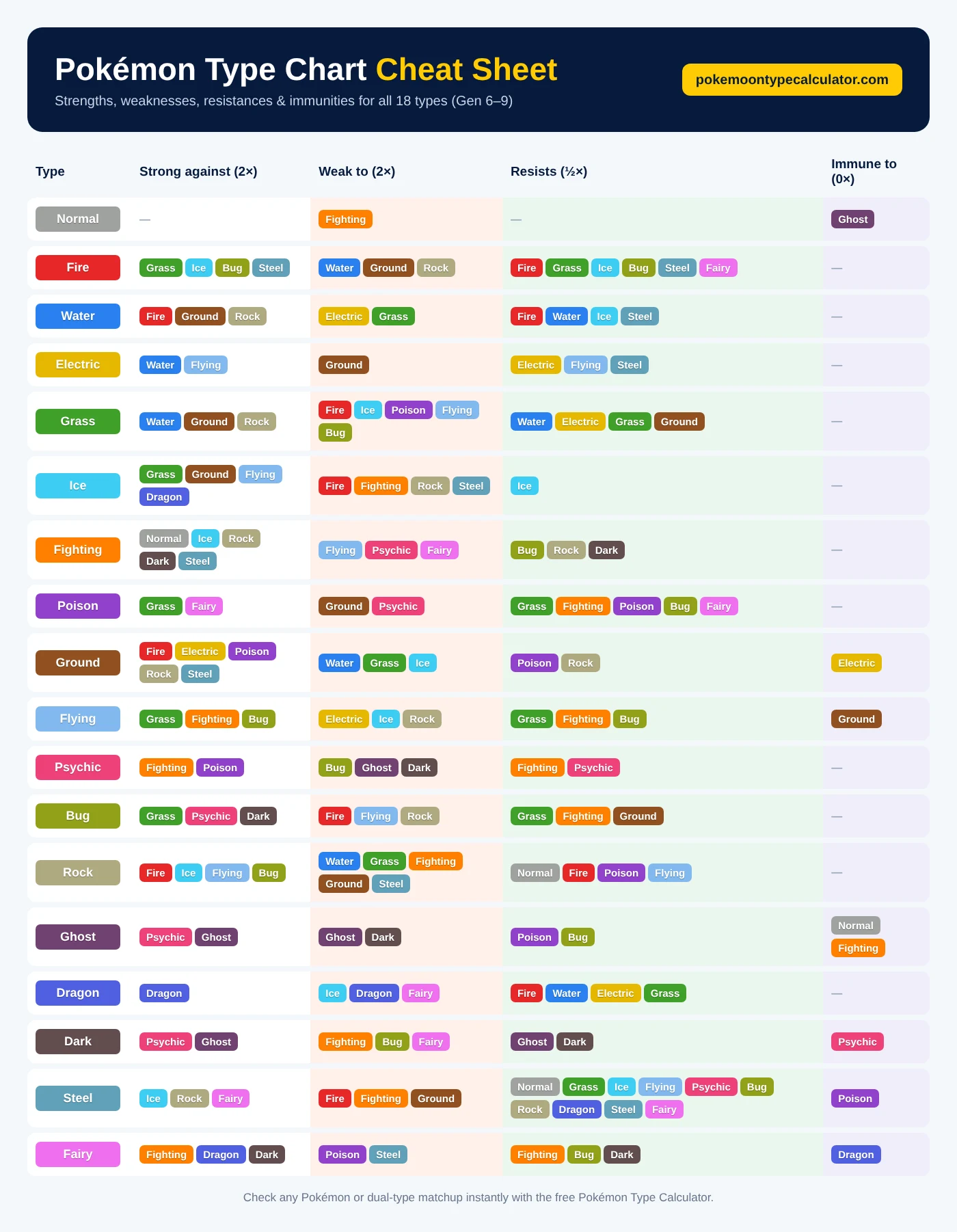
How the Pokémon Type Chart Works
The Pokémon type system determines how effective an attack is against a defending Pokémon. An attack can be super effective, normally effective, not very effective, or have no effect at all depending on the interaction between the attacking move’s type and the defending Pokémon’s type.
Use the Pokémon Type Chart above to quickly check type strengths, weaknesses, resistances, and immunities. It is useful for understanding battle matchups, choosing effective attacks, building a balanced team, and learning how different Pokémon types interact.
How to Read the Pokémon Type Chart
The chart shows the relationship between an attacking type and a defending type.
To find a matchup:
- Find the attacking type in the chart.
- Find the defending Pokémon’s type.
- Follow the row and column to see the effectiveness of the attack.
- For a dual-type Pokémon, consider the interaction with both defending types.
The result may be:
- Super Effective — the attack deals increased damage.
- Normally Effective — the attack has its standard effectiveness.
- Not Very Effective — the defending type reduces the attack’s effectiveness.
- No Effect — the defending type is immune to that type of attack.
Pokémon Type Strengths and Weaknesses
Every Pokémon type has different strengths and weaknesses. For example, some types are strong against certain opponents but vulnerable to attacks from other types.
Knowing these relationships can help you:
- Choose the right move during a battle
- Identify a Pokémon’s weaknesses
- Find effective type advantages
- Build better teams
- Plan switches against incoming attacks
- Understand why certain attacks deal more or less damage
The best way to use the chart is to look at the matchup from both sides: what the attacking type is strong against and what the defending Pokémon is weak to.
🛡️ Pokémon Type Resistances
A resistance means that a Pokémon takes reduced damage from a particular type of attack. When a defending type resists an attacking type, the move is less effective than it would be against a neutral target. Resistances are important when choosing which Pokémon to send into battle, especially when you want to reduce the damage from an opponent’s likely attack.
A Pokémon with multiple defensive advantages may be able to resist several types of attacks, making its type combination especially useful in certain matchups.
🚫 Pokémon Type Immunities
An immunity is the strongest form of type defense. When a Pokémon is immune to a type of attack, that attack has no effect.
For example, some type interactions completely prevent certain attacks from affecting the defending Pokémon. These matchups can be strategically important because they may allow a player to switch into an attack without taking damage from that type.
When checking the chart, always look for immunities as well as ordinary resistances.
Single-Type Matchups
A single-type Pokémon has one defending type. Its matchup is usually straightforward: compare the attacking type with the Pokémon’s single type.
For example, if a Pokémon has only one type, you can use the chart to quickly determine:
- Which types are super effective against it
- Which types it resists
- Which attacks have no effect
- Which matchups are neutral
Single-type matchups are a useful starting point for learning the basic Pokémon type system.
Dual-Type Pokémon Matchups
Dual-type Pokémon have two defending types, so their type effectiveness can be more complex.
An attack interacts with both defending types, and the final result depends on the combined matchup. This can create several different outcomes:
- Both defending types are weak to the attack
- One type is weak while the other resists it
- Both types resist the attack
- One type provides an immunity
- The two type interactions combine to create a neutral result
This is why dual-type Pokémon can have very different defensive profiles from single-type Pokémon.
For a specific dual-type matchup, a Pokémon Type Calculator can provide the combined result more quickly than manually checking each interaction.
⚔️ What Does Super Effective Mean?
A super-effective attack has a type advantage against the defending Pokémon. It deals more damage than a neutral attack under the relevant battle rules.
When planning an attack, finding a type that the opponent is weak against can make a major difference. This is one of the main reasons the type chart is important for both casual and competitive battles.
🛡️ What Does Not Very Effective Mean?
A not-very-effective attack is resisted by the defending Pokémon’s type.
The move still affects the target, but its damage is reduced compared with a neutral matchup. If the opponent resists your chosen attack, another move or Pokémon may be a better option.
What Does Immune Mean?
When a type is immune to an attack type, the attack has no effect on the target.
This is different from a resistance. A resistance reduces damage, while an immunity prevents the attack from affecting the target according to the applicable game mechanics.
Every Type Ranked: Strengths, Weaknesses and Resistances
This table counts how many types each type hits super effectively, how many it is weak to, how many it resists and how many it is immune to. Higher numbers in the first, fourth and fifth columns are good, and a high number in the second column means the type has many weaknesses.
| Type | Super effective against | Weak to | Resists | Immune to |
|---|---|---|---|---|
| Normal | 0 | 1 | 0 | 1 |
| Fire | 4 | 3 | 6 | 0 |
| Water | 3 | 2 | 4 | 0 |
| Electric | 2 | 1 | 3 | 0 |
| Grass | 3 | 5 | 4 | 0 |
| Ice | 4 | 4 | 1 | 0 |
| Fighting | 5 | 3 | 3 | 0 |
| Poison | 2 | 2 | 5 | 0 |
| Ground | 5 | 3 | 2 | 1 |
| Flying | 3 | 3 | 3 | 1 |
| Psychic | 2 | 3 | 2 | 0 |
| Bug | 3 | 3 | 3 | 0 |
| Rock | 4 | 5 | 4 | 0 |
| Ghost | 2 | 2 | 2 | 2 |
| Dragon | 1 | 3 | 4 | 0 |
| Dark | 2 | 3 | 2 | 1 |
| Steel | 3 | 3 | 10 | 1 |
| Fairy | 3 | 2 | 3 | 1 |
- Steel has the best defence: 10 resistances plus a Poison immunity, and only 3 weaknesses.
- Fighting and Ground have the best offence, each hitting 5 types for super effective damage.
- Grass and Rock have the most weaknesses (5 each), and Ice resists only itself.
- Normal is not super effective against any type, but it is only weak to Fighting and immune to Ghost.
How to Use the Chart for Team Building
The Pokémon Type Chart can help you identify weaknesses across an entire team.
When building a team, check whether multiple Pokémon share the same weaknesses. You can also look for useful resistances and immunities that help cover your team’s defensive gaps.
A balanced team often benefits from having different type combinations so that one weakness does not affect every member of the team.
A useful team-building process is:
- Identify each Pokémon’s weaknesses.
- Look for repeated weaknesses across the team.
- Add Pokémon that resist or are immune to those types.
- Check offensive coverage so your team can deal with a wide range of opponents.
- Review the final type matchups using the chart.
Pokémon Type Chart vs. Pokémon Type Calculator
The chart is useful when you want to study the complete type system or compare many types at once.
A calculator is more convenient when you want to check one specific matchup quickly.
Use the Type Chart when you want to:
- Explore the complete type system
- Study type relationships
- Compare multiple attacking types
- Learn general strengths and weaknesses
Use a Type Calculator when you want to:
- Check a specific matchup
- Analyze a dual-type Pokémon
- Quickly calculate combined effectiveness
- Get a simple result without manually reading the full chart
Both tools are useful, but they serve slightly different purposes.
About This Chart and Its Sources
This chart is maintained by Mical Boje, a Pokémon player for more than 10 years, and uses the same data as the Pokémon Type Calculator, so every multiplier matches.
- Rules used: the type chart from Gen 6 (X and Y) to Scarlet and Violet. For Gen 1 or Gen 2–5 rules, switch the generation in the calculator.
- Sources: the official main-series games, cross-checked against Bulbapedia’s type page.
- Last updated: . The chart is now plain HTML, so it loads instantly and can be read by search engines and AI assistants.
Frequently Asked Questions
What is the Pokémon Type Chart?
The Pokémon Type Chart is a reference showing how different Pokémon types interact with one another. It identifies type advantages, weaknesses, resistances, and immunities.
How do I use the Pokémon Type Chart?
Choose an attacking type and compare it with the defending Pokémon’s type. The chart shows whether the attack is super effective, normally effective, not very effective, or has no effect.
What is a type weakness?
A type weakness means that a Pokémon takes increased damage from a particular attacking type.
What is a type resistance?
A type resistance means that a Pokémon takes reduced damage from a particular attacking type.
What is a type immunity?
A type immunity means that a specific type of attack has no effect against the defending Pokémon.
How do dual-type matchups work?
A dual-type Pokémon has two defending types. The attacking type interacts with both types, and the combined interactions determine the final effectiveness of the attack.
Is a Pokémon Type Chart useful for team building?
Yes. It can help you find repeated weaknesses, identify useful resistances, and improve both the offensive and defensive balance of a team.
What is the difference between a type chart and a type calculator?
A type chart is a complete reference for studying type relationships. A calculator is designed to quickly calculate the result of a specific single-type or dual-type matchup.
How can I quickly check a specific type matchup?
For a single matchup, use a Pokémon Type Calculator. It can provide a direct result without requiring you to manually compare multiple rows and columns in the complete chart.
Explore Pokémon Type Matchups
The Pokémon type system becomes much easier to understand when you know how strengths, weaknesses, resistances, and immunities work together.
Use the complete Pokémon Type Chart above to study type relationships, or check a specific matchup with a Pokémon Type Calculator when you need a quick answer during team building or battle preparation.
Every type has a full weakness guide. To check dual types or individual Pokémon, use the Pokémon Type Calculator, where you can also check dual types and individual Pokémon.